
Introduction to IT PC RMM Tools and Their Role in Modern IT
The IT PC RMM Tools Technology Trend Timeline: Complete Evolution Guide (2000–2026) begins with understanding remote monitoring and management tools for PCs, and what IT PC RMM tools are and how they work. These platforms watch devices using real-time system health monitoring software. They show data in a centralized dashboard for endpoint management. Teams fix issues before users complain. This explains why businesses need remote monitoring tools today.
Modern companies rely on cloud-based remote IT management platforms to support hybrid staff. Tools deliver endpoint monitoring solutions for the remote workforce and enhance the role of RMM tools in modern hybrid work environments. Many use predictive monitoring tools for enterprise PCs to stop failures early. This shift proves the benefits of proactive IT monitoring for organizations across the United States.
Why RMM Tools Became Essential for Businesses (Early 2000s)
In the early 2000s, support was reactive. Technicians traveled between sites to manage remote desktops for tasks across multiple offices. The rise of proactive IT system monitoring software changed expectations. Companies discovered why proactive IT maintenance matters. Early adopters saw fewer outages and happier staff.
The growth of MSPs has driven demand for RMM tools among managed service providers. Providers needed scalable remote IT infrastructure management to serve many clients. Leaders learned how MSPs manage thousands of endpoints remotely using automation. This era marks the start of the evolution of IT PC RMM tools, 2000–2026.
IT PC RMM Tools Technology Trend Timeline (2000–2010): The Beginning of Remote IT
Between 2000 and 2010, tools focused on monitoring. Early agents enabled real-time system health monitoring software and alerts. Businesses noticed how RMM tools reduce IT downtime and support tickets. Vendors added automated patch management for Windows endpoints to keep systems up to date.
Security concerns also appeared. Companies began exploring security integration in modern RMM platforms. Teams asked about common mistakes when adopting RMM tools after experiencing alert overload. This decade laid the groundwork for the modern IT PC RMM Tools Technology Trend Timeline: Complete Evolution Guide (2000–2026).
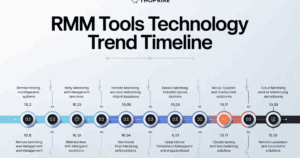
RMM Technology Evolution Timeline
| Period | Key Developments | Main Features Introduced | Impact on IT Teams |
|---|---|---|---|
| 2000–2005 | Early Remote Access Tools | Basic remote desktop control | Reduced onsite visits |
| 2006–2010 | Monitoring Agents | System alerts, performance tracking | Start of proactive IT |
| 2011–2015 | Cloud Integration | Automation, patch management | Faster support delivery |
| 2016–2020 | Security Focus | Endpoint protection, compliance | Stronger cybersecurity |
| 2021–2026 | AI & Predictive Monitoring | Automation, zero-touch IT | Intelligent IT operations |
IT PC RMM Evolution (2010–2015): Automation and Cloud Integration
Cloud computing reshaped the market. Vendors launched cloud-based remote IT management platforms with scripting features. This period showed how automation is changing IT support operations. Automation reduced manual tasks and improved speed. Many organizations sought the best RMM tools for small-business IT management.
Integration improved security. Platforms delivered how RMM platforms improve cybersecurity posture through patching and antivirus links. Teams followed a step-by-step guide to implementing RMM software to avoid failures. The IT PC RMM tools evolution timeline, 2000–2026, shows this era as the era of automation breakthroughs.
IT PC RMM Transformation (2016–2020): Security, Scalability, and MSP Growth
Cyberattacks forced innovation. Vendors strengthened security integration in modern RMM platforms and compliance tools. Enterprises adopted scalable remote IT infrastructure management for growth. Providers refined RMM deployment best practices for IT teams to secure access.
MSPs expanded their services using RMM tools. They optimized processes to show how MSPs manage thousands of endpoints remotely. Companies carefully evaluated how to choose the right RMM platform. This stage matured the IT PC RMM Tools Technology Trend Timeline: Complete Evolution Guide (2000–2026).
Latest Innovations (2021–2026): AI, Predictive Monitoring, and Zero-Touch IT

Recent years introduced intelligence. Vendors added AI-driven RMM automation in IT support and analytics. These features demonstrate how AI is transforming remote IT management. Systems now predict failures using predictive monitoring tools for enterprise PCs. Businesses benefit from fewer disruptions.
Zero-touch deployment supports remote teams. Tools deliver endpoint monitoring solutions for the remote workforce without onsite visits. Analysts highlight future trends in AI-driven remote monitoring and management. This phase defines the modern edge of the evolution of IT PC RMM tools from 2000 to 2026.
Key Benefits of Modern IT PC RMM Tools for IT Teams
Modern platforms provide visibility and control. Teams rely on ca entralized dashboard for endpoint management to track devices. They see how RMM tools reduce IT downtime and support tickets through automation. This produces measurable savings and stability.
Security also improves. Continuous updates via automated patch management for Windows endpoints close vulnerabilities. Leaders recognize the benefits of proactive IT monitoring for organizations. These advantages explain why businesses need remote monitoring tools today more than ever.
Key Takeaways from the IT PC RMM Tools Technology Trend Timeline (2000–2026):
-
Understand what IT PC RMM tools are and how they work for modern IT teams.
-
Learn how RMM tools reduce IT downtime and support tickets across PCs and endpoints.
-
Discover remote monitoring and management tools for PCs and their evolution from 2000 to 2026.
-
Explore AI-driven RMM automation and predictive monitoring features in IT support.
-
Find out how to choose the right RMM platform for your company and avoid common mistakes.
How to Choose the Right RMM Tool for Your Organization
Selection requires planning. Companies compare features across cloud-based remote IT management platforms and the depth of automation. Decision-makers examine how to choose the right RMM platform for their company based on size and budget. They also review common mistakes when adopting RMM tools to avoid risk.
Usability matters. Teams want solutions that support remote desktop management across multiple offices and reporting. Many follow a step-by-step guide to implementing RMM software before purchase. This careful approach ensures success in the IT PC RMM Tools Technology Trend Timeline: Complete Evolution Guide (2000–2026).
Comparison of RMM Tool Capabilities
| Feature | Why It Matters | What to Look For |
|---|---|---|
| Monitoring & Alerts | Prevent downtime | Real-time notifications |
| Automation | Save IT time | Script support, scheduling |
| Security Integration | Protect endpoints | Antivirus + patching |
| Scalability | Support growth | Multi-site management |
| Ease of Use | Faster adoption | Simple dashboard |
Implementation Best Practices for Successful RMM Deployment
Successful rollout starts with planning. Experts recommend RMM deployment best practices for IT teams, such as pilot testing. Organizations document processes to support scalable remote IT infrastructure management. Training ensures staff use automation properly.
Monitoring must evolve. Teams review alerts to prevent overload and follow common mistakes when adopting RMM tools, lessons learned. Continuous tuning supports the effectiveness of proactive IT system monitoring software. This disciplined method improves outcomes across the IT PC RMM tools evolution timeline 2000–2026.
Future Trends Beyond 2026: What’s Next for RMM Technology
Future systems will become autonomous. Experts predict stronger AI-driven RMM automation in IT support and self-healing devices. Analysts emphasize future trends in remote monitoring and management driven by machine learning. Organizations will rely on deeper analytics.
Edge computing will expand needs. Businesses will demand advanced endpoint monitoring solutions for the remote workforce worldwide. Leaders expect smarter tools that show how automation is further changing IT support operations. These shifts will extend the IT PC RMM Tools Technology Trend Timeline: Complete Evolution Guide (2000–2026) into a new era.
Conclusion: The Complete Evolution of IT PC RMM Tools (2000–2026)
The journey from manual support to intelligent automation defines modern IT. The IT PC RMM Tools Technology Trend Timeline: Complete Evolution Guide (2000–2026) shows how innovation transformed operations. Organizations adopting these tools gain efficiency, security, and resilience.
Looking ahead, companies must invest in proactive strategies. Understanding why proactive IT maintenance matters for businesses ensures readiness. Those who embrace change will lead the next phase of the IT PC RMM tools evolution timeline 2000–2026 and shape the future of IT management.
FAQ’s
What is RMM in the IT industry?
RMM (Remote Monitoring and Management) is a technology that lets IT teams monitor, manage, and fix computers remotely.
It helps automate maintenance, updates, and security without requiring physical access to devices.
What’s the leading RMM software for IT?
Top RMM platforms include ConnectWise Automate, NinjaOne, and Datto RMM.
They offer automation, monitoring, patching, and remote control for IT teams and MSPs.
What are some examples of RMM tools?
Popular examples are Atera, ManageEngine Endpoint Central, and Kaseya VSA.
These tools help manage endpoints, deploy updates, and monitor system health remotely.
What are the RMM tools that you have used before?
I don’t personally use software, but many IT professionals report using N-able N-central and Pulseway.
These are known for real-time monitoring, mobile management, and automation features.
