

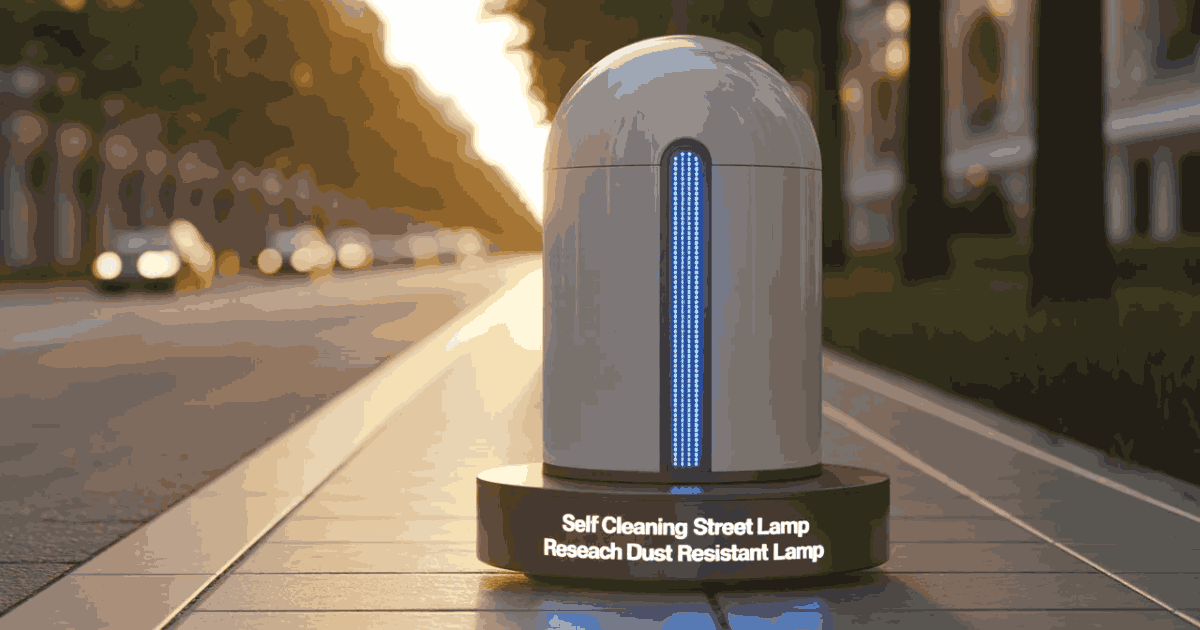
H2: Introduction to Self-Cleaning Street Lamp Research Dust-Resistant Lamp Project Exist
Cities across the United States are investing in smarter infrastructure, and the idea behind the Self-Cleaning Street Lamp Research Dust Resistant Lamp Project has quickly gained attention. Engineers study how a self-cleaning street lamp technology for dusty environments can improve performance, reduce labor costs, and extend system life. Many researchers ask if the self-cleaning street lamp research project really exists, and the answer lies in growing prototype development and field trials. This concept blends materials science, mechanical engineering, and automation to create lighting that operates efficiently in challenging outdoor conditions.
At its core, this research explores a dust-resistant street light research project that focuses on durability and automation. Experts combine smart street lighting with self-cleaning system strategies with real-world testing to ensure practical value. The main goal is to improve the reliability of outdoor lighting in high-dust regions while reducing maintenance burden on municipalities. Engineers increasingly publish findings in what many describe as a developer’s guide to dust-resistant lamp research, helping cities understand scalability and long-term savings.
H2: Why Dust Resistance Matters in Modern Street Lighting
Dust may seem harmless, yet the environmental dust impact on street lamp performance is significant. Even a thin layer of particles can reduce illumination and visibility, affecting pedestrian safety and road navigation. Researchers often explain why dust-resistant street lamps are important for cities, noting that lighting loss leads to higher energy use and increased maintenance cycles. This problem becomes more visible in dry states where pollution and wind carry continuous debris.
A smart, dust-resistant lighting solution for cities offers more than convenience. It improves safety, extends lamp life, and reduces cleaning costs. City planners studying the advantages of dust-resistant street lighting systems often notice lower operational budgets over time. The discussion also connects to the cost and maintenance benefits of self-cleaning street lights, where automated systems reduce manual intervention, allowing maintenance teams to focus on critical repairs rather than routine cleaning.
H2: How Self-Cleaning Street Lamp Technology Actually Works
H3: Functional Design Behind Self-Cleaning Street Lamp Research Dust-Resistant Lamp Project Exist

Understanding how self-cleaning street lamps work in dusty areas requires examining multiple layers that work together. The design combines a sealed housing, surface treatments, and sensors that trigger cleaning when dust reaches a set threshold. Engineers rely on a self-cleaning lamp housing engineering concept that prevents particles from entering sensitive components. This structure supports energy-efficient self-cleaning street lamps by reducing power waste caused by blocked light surfaces.
Most systems use an automated dust-removal mechanism for street lamps, paired with control software. Sensors measure light loss and environmental conditions, then activate an intelligent street lamp cleaning mechanism only when needed. This balance keeps power consumption low while ensuring reliability. Researchers developing a self-cleaning street lamp for smart city infrastructure often integrate IoT monitoring to enable remote tracking of efficiency.
H2: Core Technologies Behind Dust-Resistant Lamp Projects
Materials play the biggest role in making a lamp self-cleaning. Engineers apply hydrophobic coatings to outdoor lighting systems so water and dust slide off naturally rather than sticking. Another common approach uses nanocoating technology on street lights, allowing surfaces to repel contaminants while maintaining optical clarity. These innovations help explain the best dust-resistant street lamp technology, as explained in many research studies.
Electronics add intelligence to the system. Sensors, embedded controllers, and predictive algorithms turn a simple lamp into a smart device. Researchers developing prototypes for dust-resistant lamps combine hardware and software to achieve adaptive performance. These advances support future research on smart street lighting, in which systems automatically adjust cleaning cycles based on weather patterns and pollution data.
H2: Types of Self-Cleaning Mechanisms Used in Street Lamps
Cleaning mechanisms vary based on cost and environment. Some designs rely on vibration-based methods to dislodge dust particles. Others use brushes or rotating arms to remove heavier buildup. These approaches represent the common self-cleaning mechanism used in modern street lights found in pilot projects. Engineers testing scalable self-cleaning street lamp project ideas often compare multiple designs to find the most reliable system.
Another popular method uses electrostatic or airflow-based cleaning, reducing the number of moving parts. This style aligns with the goals of low-maintenance, self-cleaning street lighting systems because fewer components mean fewer failures. Research also explores passive systems that use rainwater or airflow channels to assist cleaning, contributing to real-world examples of self-cleaning street lamps being tested in different climates.
Comparison of Self-Cleaning Mechanisms in Dust-Resistant Street Lamp Projects
| Mechanism Type | How It Works | Advantages | Best Use Case |
|---|---|---|---|
| Vibration System | Shakes off dust using motorized vibration | Low energy use, simple design | Areas with light dust accumulation |
| Mechanical Wipers | Rotating brushes or wipers remove debris | Effective against heavy dust | Solar street lamps or industrial zones |
| Electrostatic Cleaning | Uses electric fields to repel dust | No moving parts, low maintenance | Urban areas with fine particulate matter |
| Rain-Assisted Cleaning | Channels rainwater to wash lamp surfaces | Eco-friendly, low cost | Regions with regular rainfall |
| Hybrid Methods | Combines two or more techniques | High reliability, adaptive | High-dust environments need maximum efficiency |
H2: Real-World Examples Where These Lamp Projects Exist
Many cities and universities have started field testing smart lighting concepts. Early pilot studies on dust-resistant solar street lamp design demonstrate that solar efficiency increases when surfaces remain clean. These experiments support claims around self-cleaning solar street lamp research guide principles, showing measurable performance improvements in high-dust regions.
Urban innovation zones in the US and overseas have tested lamps with automated cleaning cycles. These studies help validate methods for building a self-cleaning street lamp project in practical settings. Engineers monitor energy use, cleaning frequency, and brightness stability to measure success. Such programs continue to prove that the idea of a Self-Cleaning Street Lamp Research Dust-Resistant Lamp Project exists, is not just theoretical but increasingly practical.
H2: Key Components Required for a Successful Research Project

A successful research model combines mechanical design, electronics, and software intelligence. Sealed lamp housings protect internal circuits while smart controllers manage sensor data. Researchers designing the intelligent street lamp cleaning mechanism place strong emphasis on reliability and weather resistance to ensure long-term performance. This integrated approach forms the foundation for modern smart lighting research.
Developers also rely on testing chambers, light meters, and analytics tools to evaluate results. These tools allow accurate measurement of dust accumulation and cleaning efficiency. Through careful experimentation, teams refine prototype development for dust-resistant lamp projects and improve scalability. This process strengthens confidence in deploying these systems city-wide in the near future.
Essential Components for a Successful Self-Cleaning Dust-Resistant Lamp Research Project
| Component | Purpose | Example / Detail |
|---|---|---|
| Lamp Housing | Protects internal electronics | Sealed IP65+ enclosure |
| Sensors | Monitor dust and light levels | LDR sensors, optical dust sensors |
| Microcontroller | Automates cleaning cycles | Arduino, ESP32, STM32 |
| Cleaning Mechanism | Removes dust | Vibrators, wipers, electrostatic systems |
| Software/Firmware | Controls operation and monitoring | Threshold-based cleaning logic, IoT dashboards |
| Testing Tools | Evaluate performance | Dust chambers, lux meters, surface adhesion tests |
| Data Analytics | Optimize design and frequency | Lumen degradation logs, cleaning cycle efficiency |
H2: Benefits of Self-Cleaning Dust-Resistant Street Lamps for Smart Cities
The biggest advantage is consistency. Smart lighting that cleans itself delivers reliable brightness and reduces the need for maintenance visits. Cities that implement smart street lighting with self-cleaning systems report improved safety perception and better operational efficiency. These systems also support sustainability goals by reducing waste and extending equipment lifespan.
Financial benefits matter too. Decision-makers analyzing the cost and maintenance benefits of self-cleaning street lights see long-term savings despite higher initial costs. Cleaner lights consume energy more efficiently and reduce technician workload. This makes the technology attractive for municipalities seeking innovative yet practical infrastructure upgrades.
H2: Major Challenges and Limitations in Current Projects
Despite progress, several barriers remain. One major issue is system complexity, since moving parts may fail over time. Researchers often discuss the challenges of developing dust-resistant lamps because durability must match real-world conditions. Power consumption also requires careful balance, particularly for solar-powered systems.
Another limitation involves large-scale implementation. Cities must test materials and mechanisms across different climates before adoption. Designers continue to refine models to improve reliability and reduce costs. Even so, researchers agree that continuous innovation keeps pushing the technology forward toward wider acceptance.
H2: Future Research Trends and Innovations in Self-Cleaning Street Lamps
Future innovation focuses on smarter automation and adaptive systems. Engineers are developing AI-driven cleaning schedules that respond to weather patterns and pollution levels. This aligns with future research trends in smart street lighting, where lamps will become fully autonomous infrastructure units capable of self-monitoring and self-optimization.
Advances in materials science also promise better durability. New coatings and lightweight designs will improve energy savings and reduce wear. As research evolves, more cities will explore self-cleaning street lamps for smart city infrastructure strategies to meet sustainability targets. The direction is clear: smarter, cleaner, and more efficient outdoor lighting systems.
H2: Conclusion
The Self-Cleaning Street Lamp Research Dust-Resistant Lamp Project Exist concept reflects the future of urban lighting innovation. By combining intelligent design, advanced materials, and automation, researchers are building systems that solve real-world dust challenges. This technology enhances safety, reduces maintenance requirements, and supports sustainable development goals.
As cities move toward smarter infrastructure, self-cleaning and dust-resistant lamps will likely become standard rather than experimental. Continued research, testing, and scalable design improvements will determine how quickly these systems expand. For developers, engineers, and planners, this field offers one of the most promising directions in modern lighting engineering.
Faq’s
Q1: What are old street lamps made of?
Old street lamps were mostly made of cast iron or steel for the poles, with glass enclosures housing oil or gas flames. These materials provided durability but required frequent maintenance.
Q2: What powers the modern street lamp?
Modern street lamps are powered by electricity, often connected to the grid or solar panels. Solar-powered lamps store energy during the day for nighttime illumination.
Q3: How to reduce light pollution from street lamps?
Use downward-facing fixtures and shields to limit stray light. Opt for LED lamps with lower intensity and warmer color temperatures.
